Hospital Negligence in Pakistan:
Reused Syringes Linked to HIV Cases in Children
Description:
A shocking investigation reveals how reused syringes at a public hospital in Taunsa Sharif led to hundreds of children contracting HIV. Full details inside.
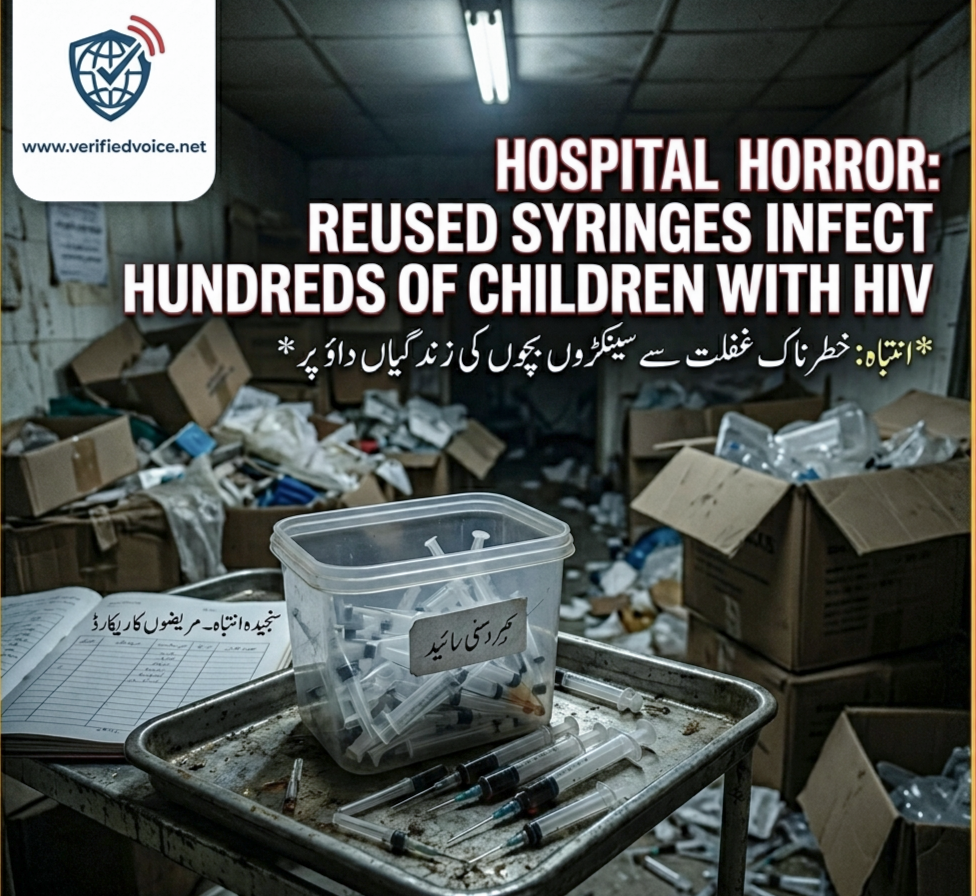
A disturbing investigation by BBC Eye has uncovered a serious healthcare lapse in Pakistan, where unsafe medical practices are believed to have infected hundreds of children with HIV.
According to the report, at least 331 children tested positive for HIV between November 2024 and October 2025. The cases have been traced back to a single government-run facility, THQ Taunsa Sharif, raising alarming concerns about patient safety standards.
During a 32-hour undercover operation, investigators documented multiple instances where the same syringe was reused. In at least 10 separate cases, medical staff used one syringe repeatedly with a multi-dose vial. In four of those incidents, the same contaminated vial was administered to different children—significantly increasing the risk of virus transmission.
A relative of one affected child described the situation, saying the syringe was used on one patient and then reused for another without proper sterilization. This practice allowed the virus to spread easily between patients.
Health experts warn that simply changing the needle does not eliminate the risk. Infectious disease specialist Altaf Ahmed explained that the virus can remain in the syringe barrel, meaning even a fresh needle cannot prevent contamination if the same syringe body is reused.
The issue reportedly surfaced earlier in late 2024 when a private clinic flagged similar concerns, leading to the dismissal of a hospital administrator. However, despite this action, the problem appears to have persisted.
The current medical superintendent, Qasim Buzdar, has questioned the authenticity of the undercover footage, suggesting it could be staged. Despite the serious allegations, he reassured the public, stating that patients should continue seeking treatment at the hospital with confidence.
This is not the first time such negligence has been reported in the region, which raises critical questions about accountability and oversight in public healthcare facilities. As investigations continue, families affected by this tragedy are left to deal with lifelong consequences—many of which could have been avoided through basic medical safety protocols.