India-Pakistan War One Year Later: Lessons, Losses and Rising Regional Tensions
Both Nations Continue Claiming Victory After 2025 Conflict, But Security Experts Warn Major Risks Still Remain
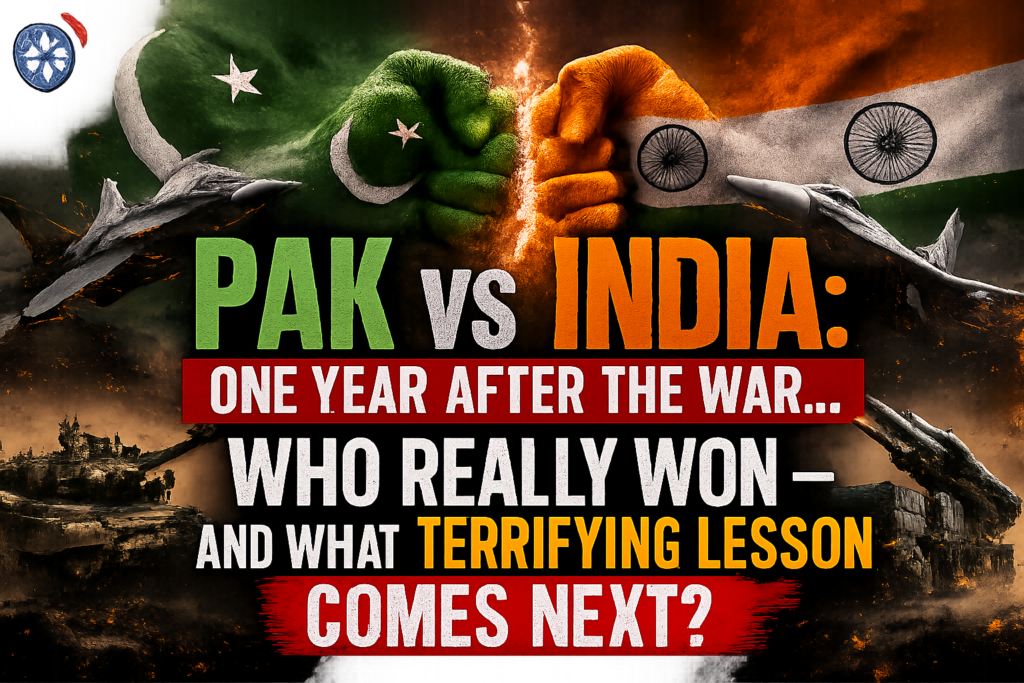
Islamabad: One year after the brief but intense four-day military confrontation between Pakistan and India, both countries continue presenting the conflict as a strategic success for their own side. However, analysts believe the 2025 crisis exposed serious weaknesses in military preparedness, diplomacy, air defence systems and regional stability for both nuclear powers.
Across Pakistan, May 2026 began with public events, banners and ceremonies remembering what officials describe as a successful defence operation against India during last year’s confrontation. Military achievements were highlighted at official gatherings in Rawalpindi and Lahore, where the Pakistan Air Force and government institutions praised the armed forces for their response during the conflict.
Meanwhile, India also marked the anniversary with patriotic messaging and renewed support for Operation Sindoor — the military operation launched after the deadly attack in Pahalgam, Indian-administered Kashmir, in April 2025. Indian Prime Minister Narendra Modi publicly praised the country’s armed forces and repeated India’s commitment against terrorism.
How the 2025 Conflict Started
The tensions escalated after gunmen attacked tourists in Pahalgam on April 22, 2025, killing 26 civilians. India blamed Pakistan-based elements for the attack, while Islamabad strongly denied involvement.
In response, India launched missile and air strikes targeting multiple locations inside Pakistan and Pakistan-administered Kashmir under Operation Sindoor. Pakistan retaliated with Operation Bunyan al-Marsoos, leading to four days of military escalation involving fighter jets, drones and missile attacks.
Although both sides later announced success, independent analysts argue that neither country achieved a complete military victory.
Pakistan’s Claimed Successes
Pakistan highlighted its aerial combat performance during the opening phase of the conflict. Pakistani officials claimed that Chinese-made J-10C fighter aircraft successfully targeted several Indian jets, including Rafale fighters.
Later, Indian military officials acknowledged that aircraft losses occurred during combat operations, though detailed numbers were never publicly confirmed.
Pakistan also gained diplomatic attention after openly supporting former US President Donald Trump for helping secure a ceasefire in May 2025. Over the following months, Pakistan’s military leadership gained increased international visibility, especially during Middle East diplomatic developments involving Iran and the United States.
India’s Military Gains and Strategic Pressure
India, on the other hand, pointed to successful long-range strikes carried out with BrahMos missiles, which reportedly targeted key Pakistani airbases including Nur Khan and Bholari.
Indian forces also used Israeli-made drones capable of reaching deep inside Pakistani territory, including areas near Karachi and Lahore. Another major step taken by India was the suspension of the Indus Waters Treaty in April 2025 — a move that significantly increased regional tensions.
Defence analysts believe India demonstrated its ability to launch precision strikes at long distances, while Pakistan showed strength in aerial defence and retaliatory operations.
Pakistan Increasing Defence Capabilities
Following the war, Pakistan accelerated military modernisation efforts. Officials announced the operational launch of the Army Rocket Force Command (ARFC), designed to strengthen long-range conventional strike capabilities.
Pakistan also introduced upgraded missile systems including Fatah-III, Fatah-IV and Fatah-V. Defence experts say these systems are intended to improve Pakistan’s response capability against high-speed missile threats such as India’s BrahMos.
The country also increased defence spending by nearly 20 percent, allocating billions for military hardware, air defence systems and weapons upgrades.
Reports further suggested that China offered advanced J-35A fifth-generation fighter jets to Pakistan, while the United States approved a package to extend the operational life of Pakistan’s F-16 fleet.
Weaknesses Exposed During the Conflict
Despite these developments, analysts say the conflict exposed major vulnerabilities on both sides.
Pakistan’s air defence systems struggled against BrahMos missile attacks during later stages of the war. Several military installations reportedly suffered damage, raising concerns about the country’s preparedness against hypersonic and long-range precision weapons.
Experts also warned that modern warfare has reduced the importance of geographical distance. Cities and strategic military bases once considered relatively secure are now increasingly vulnerable to drones, missile systems and satellite-guided strikes.
India also faced criticism regarding aircraft losses and the handling of military information during the conflict. Observers noted that misinformation campaigns on social media played a significant role throughout the confrontation, allowing both sides to shape public narratives in their favour.
Growing Water Dispute Raises New Concerns
Beyond military tensions, the suspension of the Indus Waters Treaty has become one of the most worrying long-term consequences of the conflict.
The treaty is vital for Pakistan’s agricultural system and water supply. Experts warn that prolonged suspension could create serious economic and environmental challenges for millions of people.
Pakistani officials accused India of attempting to use water as a strategic pressure tool, while legal experts argued that the treaty does not allow unilateral suspension under international law.
Environmental specialists further warned that climate change and glacier loss could eventually become an even greater threat to regional stability than military conflict itself.
Risk of Another India-Pakistan Conflict Still Exists
Security experts believe the core issues between Pakistan and India remain unresolved even one year after the conflict. Mutual distrust, limited diplomatic communication and ongoing regional tensions continue to create risks of future escalation.
Analysts from both countries say any future conflict could escalate much faster due to advanced missile technology, drones and evolving military doctrines.
Many experts are now urging both governments to strengthen diplomatic backchannels and crisis-management mechanisms before another confrontation emerges in South Asia.
Read More:
How Operation Bunyanum Marsoos Changed the Region.