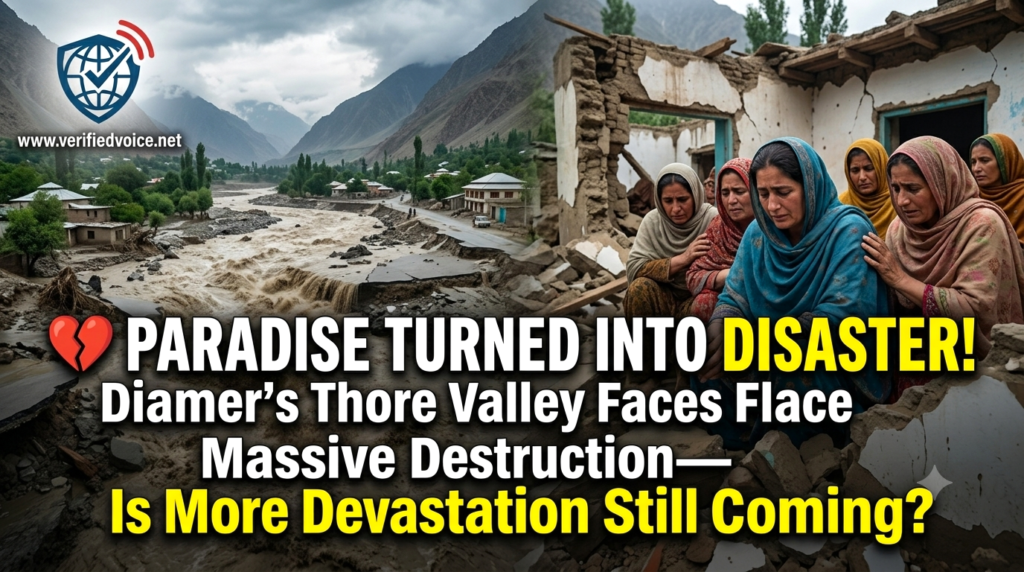
Cloudburst Floods Devastate Diamer’s Thore Valley as Glacier Melt Raises Fresh Disaster Fears
Gilgit, Pakistan: A powerful cloudburst triggered destructive flash floods in Thore Valley of Diamer district on Saturday, leaving widespread destruction in its wake. The disaster damaged homes, farmland, roads, and public infrastructure, while authorities warned that rising temperatures and rapid glacier melting could worsen the flood threat across Gilgit-Baltistan and nearby northern regions.
Homes, Roads and Farmland Suffer Heavy Damage
According to local officials, intense rainfall over the surrounding mountains caused sudden flash floods that swept through Thore Valley. The powerful torrents destroyed several houses, uprooted trees, and submerged hundreds of acres of farmland and orchards.
Critical road links and communication bridges were also washed away, cutting off several villages from the rest of the district. Many families were forced to leave their homes after floodwaters damaged residential areas, while electricity and drinking water supplies were disrupted in several locations.
Floodwaters also carried away vehicles parked along roadsides and destroyed standing crops, adding to the financial losses faced by local residents.
The flooding extended to the Wapda Colony, where staff working on the Diamer-Bhasha Dam project are housed, as well as nearby settlements, causing significant damage to buildings and infrastructure.
Relief Operations Underway
The Gilgit-Baltistan Disaster Management Authority (GBDMA) confirmed that emergency teams were immediately deployed to the affected areas. Relief efforts include the distribution of food packages, tents, clean drinking water, and other essential supplies to displaced families.
Officials stated that the valley’s main road has been reopened to restore transportation, while survey teams are assessing the full extent of the losses.
Authorities said restoring access to isolated communities and providing immediate assistance remain their highest priorities.
Meanwhile, residents have appealed to both the federal and provincial governments, as well as humanitarian organizations, for urgent support, including shelter, medical treatment, food, and financial assistance to rebuild their lives.
Rising Temperatures Increase Glacier Melt
While relief work continues, the region is also facing another growing concern. Ongoing heatwave conditions across Gilgit-Baltistan have accelerated glacier melting, causing rivers and streams to swell.
Officials warned that increasing water levels have raised the possibility of further flooding and Glacial Lake Outburst Floods (GLOFs), posing serious risks to downstream communities.
Several roads have already been affected by rising water levels. Flooding in Sadpara Nallah blocked the Deosai Road, temporarily cutting road access between Skardu and Deosai. Police also reported that several tourist vehicles became stranded due to the flooding.
In Ghizer district, water erosion damaged the road leading to the Badswat area, while rising water in Hopper Nallah destroyed crops and farmland and threatened nearby roads, bridges, and public infrastructure.
PMD Issues GLOF Warning
The Pakistan Meteorological Department (PMD) has issued a fresh advisory warning of an increased risk of Glacial Lake Outburst Floods (GLOFs) across Gilgit-Baltistan and Khyber Pakhtunkhwa.
According to the department, above-normal temperatures are expected to continue until the first week of July, leading to faster snow and glacier melt in northern valleys.
Meteorologists warned that rivers and streams are likely to experience unusually high water flows. Existing glacial lakes could expand rapidly due to excessive meltwater, while new lakes may also form, increasing the chances of sudden flooding in vulnerable areas.
Communities living near rivers, streams, and low-lying regions have been advised to remain alert and closely follow official safety instructions.
NDMA Warns of Landslides in Northern Pakistan
The National Disaster Management Authority (NDMA) has also issued a nationwide alert for northern mountainous regions, warning that continued high temperatures combined with expected rainfall could further accelerate glacier melting between June 27 and July 3.
The authority said the increased water flow could affect rivers across Gilgit-Baltistan, Khyber Pakhtunkhwa, and Azad Jammu and Kashmir (AJK).
In addition, the National Emergency Operations Centre (NEOC) warned that unstable weather conditions may trigger landslides, rockfalls, and debris flows in mountainous areas during the same period.
Residents and travelers have been advised to avoid unnecessary journeys in vulnerable regions, monitor official weather updates, and take precautionary measures as emergency authorities continue to monitor the evolving situation.
Conclusion
The disaster in Diamer’s Thore Valley highlights the growing impact of extreme weather and climate-related events in Pakistan’s northern regions. As rescue and relief operations continue, officials remain on high alert due to the combined threat of heavy rainfall, glacier melting, flash floods, and landslides that could place more communities at risk in the coming days.
Read More:
Cloudburst-induced floods wreak havoc in Diamer’s Thore Valley